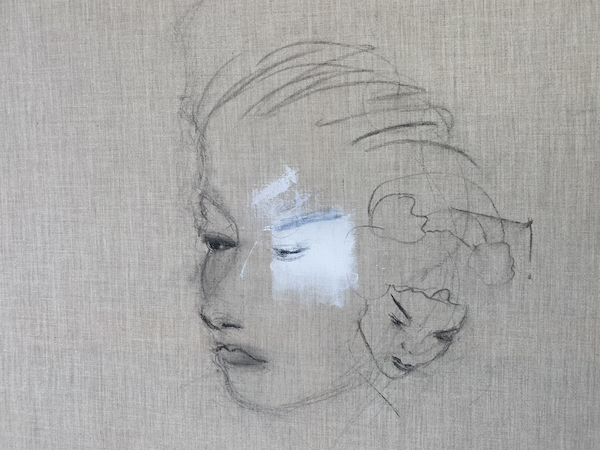
This painting is the result of a collision between obsession, memory, and atmosphere. In the isolation of my studio, the process did not begin with elaborate technique or grand ideas. It started with two rapid sketches: Maria Callas as herself, and as Madama Butterfly. Nothing more.
The point was to connect these two realities. Callas embodied contradiction. She gave herself to the illusions of the stage, most visibly as Puccini’s heroine, while her life outside remained marked by the same intensity. Like Cio-Cio-San, she gave everything, and in return received heartbreak, betrayal, and eventual retreat into a lonely, melancholic isolation in Paris, left with nothing but the memory-ghosts of her own voice and past.
The aim was to take those two sketches and force them into a single image: a life collapsing into memory.
夢
Layering the Atmosphere: The Foundation of Glazes
Translating those first quick studies onto the large canvas demanded confidence that I could get Callas’s images right in just a few minutes using black charcoal. And I did it.
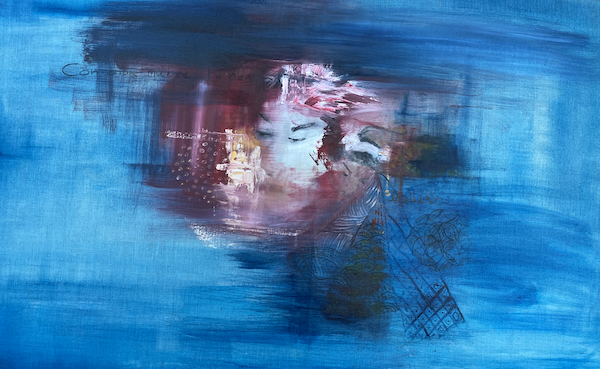
After a long pause and reconsideration, I layered the surface with glazes. A marine blue dominates across the upper part, setting a nocturnal tonspace. Against this, a muted rose and pink hazel mark the only shift—a small concession to feeling in an otherwise cool space.
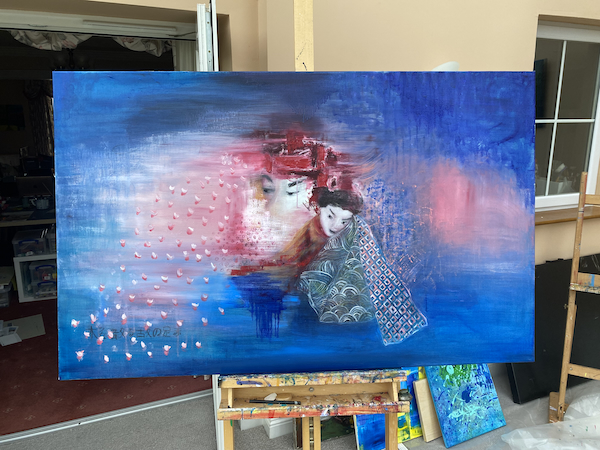
Callas’s face, layered and indistinct, merges with Butterfly. The canvas remains subdued. The reds of the Japanese architecture anchor the composition. They provide a cloud of white and pink petals that moves across the surface, a brief gesture toward impermanence.
Weaving the Script: The Palimpsest of Yume
Once the visual structure settled, it was clear the painting required a conceptual layer, something eroded and absorbed rather than imposed. I studied Japanese patterns, old and new, and selected what would be absorbed and embedded directly in its fabric—something time-worn and dissolved, rather than stamped on top of the oil glazes. I acquired two books about Japanese patterns, both ancient and modern. I studied them and decided how and which to use, and how to incorporate them into work.
From the start, I looked for kanji that could carry the weight of Callas’s and Butterfly’s tragedy. On the upper left, the character 夢 (Yume — Dream / Illusion) falls downward, echoing the petals. On the upper right, 物の哀れ (Mono no Aware — the transience of things) sits in silent balance.
Instead of rendering them in stark, opaque paint, I worked them in a muted, shimmering gold-bronze tone. The goal was to make them look eroded, swallowed by the surrounding glazes, and buried deep in the background. They aren’t words to be read instantly; they are historical traces found on a weathered wall.
The Solitude of the Easel and Finding Yume no Ato
Isolation is the default. Without the noise of institutions or critique, every choice is yours alone. The silence is necessary. In the end, the canvas revealed itself not through addition, but through restraint.
It wasn’t just Yume or Utakata; it was Yume no Ato (夢の跡)—The Traces of a Dream.
The title references a classical Japanese motif regarding what lingers after a grand dream or passion ends. It captures the aftermath of Callas’s supernova life: the echoing silence in the great opera houses after the curtain falls, the memory of an unrepeatable voice, and the quiet beauty left behind on the linen.
The Final Seal
The signature is not an interruption. It is absorbed into the lower-right margin, in the same muted gold-bronze, another trace among many.
Yume no Ato is a record of contradiction: private reality and public performance, genius and illusion, solitude and noise. The dream is gone. Only traces remain.